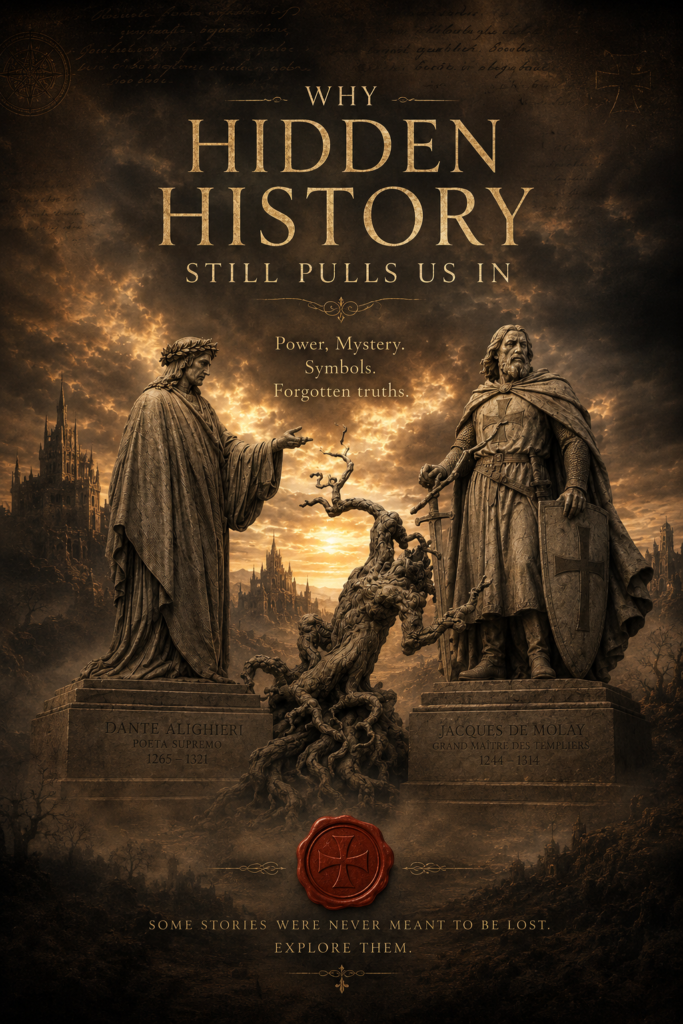
Some stories never really go away.
They survive in symbols.
They survive in legends.
They survive in old books, forgotten conflicts, strange rituals, and questions nobody seems eager to answer.
That is why hidden history still pulls us in.
It is not just about dates, kings, popes, battles, or secret societies. Those things matter. But they are not the whole reason people keep coming back to stories about the Knights Templar, Freemasonry, Dante, the Catholic Church, lost treasure, forbidden knowledge, and symbols carved into stone.
The deeper reason is mystery.
People want to know what really happened.
They want to know why powerful institutions fought so hard to control certain stories. They want to know why some orders disappeared while their symbols survived. They want to know why certain names keep returning again and again, even centuries later.
The Knights Templar were destroyed in the early 1300s, but the mystery around them never died.
Dante Alighieri wrote one of the greatest works in Western literature, but beneath the poetry was a man watching his world fall apart. He saw conflict between popes and kings. He saw exile, corruption, ambition, and spiritual crisis. He lived in the middle of a world where power was being challenged from every direction.
Freemasonry is often explained with simple answers. But the symbols, rituals, degrees, and internal conflicts tell a much deeper story than most people realize.
That is where the trail begins.
Not with dry history.
Not with conspiracy for the sake of conspiracy.
But with the questions that refuse to disappear.
Why did the Templars have to fall?
What did Dante see in the world around him?
Why did Freemasonry need a Grand Lodge in 1717 if something older already existed?
Why do certain symbols keep surviving long after the people who used them are gone?
These are the kinds of questions that make history feel alive.
Hidden history is powerful because it sits between fact and mystery. It asks us to look closer. It asks us to question the clean version of events. It asks whether the story we inherited is complete, or whether pieces were left out along the way.
That is what this site follows.
The forgotten trail.
The symbols that survived.
The conflicts beneath the surface.
The stories that were buried, simplified, or explained away.
History is often taught as if everything is settled.
But sometimes the most important questions begin where the official story ends.
Start with the free Dante guide: What Dante Knew About the Knights Templar
Explore the full investigation: Freemasons Secrets: The True Descendants of the Knights Templar