Freemasons Secrets, Hidden History

Hidden History: If Freemasonry Already Existed, Why Was a Grand Lodge Needed?

Most people are told that Freemasonry began in 1717.
Why was a Masonic Grand Lodge even needed?

That’s the familiar story.

Four lodges met in London. A Grand Lodge was formed. Organized Freemasonry stepped into history.

Simple. Clean. Official.

But there is a problem with that story.

If Freemasonry began in 1717, then why were there already lodges to gather?

And if lodges already existed before the first Grand Lodge was created, then 1717 was not really the birth of Freemasonry.

It was something else.

That is where the story becomes far more interesting.


The question hiding in plain sight

The deeper question is not whether something important happened in London in 1717. Something clearly did.

The real question is what that event actually meant.

Was it the beginning of Freemasonry?

Or was it the creation of a new authority structure over something that already existed?

That difference matters.

Because if Freemasonry already existed before 1717, then the formation of a Grand Lodge was not the start of the brotherhood. It was an attempt to organize it, define it, and place authority over it.

That raises an uncomfortable question.

Who needed that authority?

And why?


A beginning, or a takeover?

History often remembers institutions by the moment they become official.

But the official beginning is not always the real beginning.

A movement can exist before it is organized.
A tradition can survive before it is registered.
A system of symbols can be passed down before someone decides to govern it.

That may be the real issue with 1717.

The first Grand Lodge did not appear in an empty world. It appeared in a world where lodges, customs, ceremonies, and claims of older tradition were already in motion.

So when modern readers are told that Freemasonry began in 1717, they should pause.

Because the more precise question may be this:

What kind of Freemasonry began in 1717?

Not whether Masonry existed before.
Not whether men gathered before.
Not whether older traditions were already circulating.

But what new version of authority was created when the Grand Lodge stepped forward?

The fight that followed

If 1717 settled everything, then the story should have become simple after that.

But it did not.

Instead, Freemasonry entered one of the most revealing conflicts in its history: the struggle between the Moderns and the Ancients.

The Moderns were connected to the Grand Lodge system that emerged in London. The Ancients challenged them. They did not simply accept the Moderns as the natural and complete voice of Freemasonry.

That matters.

Because this conflict suggests that the issue was not just paperwork, ceremony, or social organization.

It was a fight over legitimacy.

Who had the right to speak for Masonry?
Who preserved the older system?
Who had changed it?
Who had lost something?
Who was claiming authority over something they did not fully possess?

These are not small questions.

They cut straight into the heart of the Masonic origin story.

Laurence Dermott and the voice of the Ancients

One of the most important figures in this conflict was Laurence Dermott.

Dermott became a leading voice for the Ancients, and his work did not sound like a man casually disagreeing over lodge habits.

He wrote like a man defending an inheritance.

To Dermott and the Ancients, the Moderns had not simply improved Freemasonry. They had altered it. They had departed from something older.

That is why Dermott matters.

He reminds us that the story of Freemasonry was never as unified as the official version often makes it sound.

There were men inside the Masonic world itself who believed the Moderns did not represent the full truth of the craft.

That alone should make anyone stop and reconsider the neat version of 1717.

Because if the Moderns were merely the natural continuation of older Masonry, why did the Ancients fight them so fiercely?

Frederick Dalcho and the missing tradition

Frederick Dalcho adds another piece to the puzzle.

Dalcho pointed to a deeper issue connected to the York tradition and the Royal Arch. That is important because the Royal Arch was not treated as a minor decoration by those who understood its importance.

It was treated as something essential.

That creates another problem for the simplified version of Freemasonry.

If the full meaning of the craft reached beyond what the Moderns possessed, then the public structure of Masonry was incomplete from the beginning.

And if the Moderns lacked something that the Ancients claimed to preserve, then the conflict between them becomes much more than a disagreement between two rival organizations.

It becomes a battle over what Freemasonry really was.

Why a Grand Lodge?

This brings us back to the central question.

If Freemasonry already existed before 1717, why was a Grand Lodge needed?

There are several possible answers.

Maybe it was needed to bring order.
Maybe it was needed to create public respectability.
Maybe it was needed to control competing lodges.
Maybe it was needed to reshape the fraternity into something more acceptable to the age.

Or maybe it was needed because an older tradition had to be placed under a new authority.

That possibility changes the entire story.

Because then 1717 was not just a founding date.

It was a dividing line.

Before it stood older claims, older customs, older symbols, and older mysteries.

After it came a new structure with the power to define what counted as official Masonry.

That is why the date matters.

Not because it proves Freemasonry began there, but because it may reveal the moment when one version of Freemasonry began to rise over another.

The hidden war inside Freemasonry

This is why the conflict between the Ancients and Moderns deserves more attention.

It was not just an internal argument. It was a hidden war over memory, authority, and inheritance.

The Moderns represented the new center of power.

The Ancients claimed something older.

Between them stood the question that still refuses to disappear:

Who had the real tradition?

That question matters because Freemasonry was never only about meetings and membership. It was about symbols. Ritual. Secrecy. Continuity. Meaning.

And when men fight over symbols, they are often fighting over much more than symbols.

They are fighting over the right to say what the past means.

The official story is only the surface

Official history prefers clean beginnings.

It likes dates.
It likes institutions.
It likes a clear point where one thing starts and another thing ends.

But hidden history is rarely that simple.

Sometimes the most important stories are not found in the official beginning, but in the conflict that follows.

The formation of the first Grand Lodge in 1717 may have been one of those moments.

It may not have been the birth of Freemasonry.

It may have been the moment Freemasonry was reorganized, redirected, and placed under a new form of control.

And if that is true, then the real story is not simply that Freemasonry began in London.

The real story is that something older was already there.

Something powerful enough to require a Grand Lodge.

Something contested enough to divide the brotherhood for decades.

Something important enough that men like Dermott and Dalcho refused to let the question die.

The question remains

So the question still stands:

If Freemasonry already existed before 1717, why was a Grand Lodge needed?

That question sits at the center of the hidden history.

And once you ask it, the official story begins to look less like an answer and more like the beginning of a much deeper trail.

That trail leads through the Ancients and Moderns, through the Royal Arch, through disputed traditions, and through the symbols that still survive today.

It leads to a larger possibility.

Maybe Freemasonry was not born in 1717.

Maybe 1717 was the moment someone tried to decide what Freemasonry would be allowed to become.


Go down the rabbit hole of history …

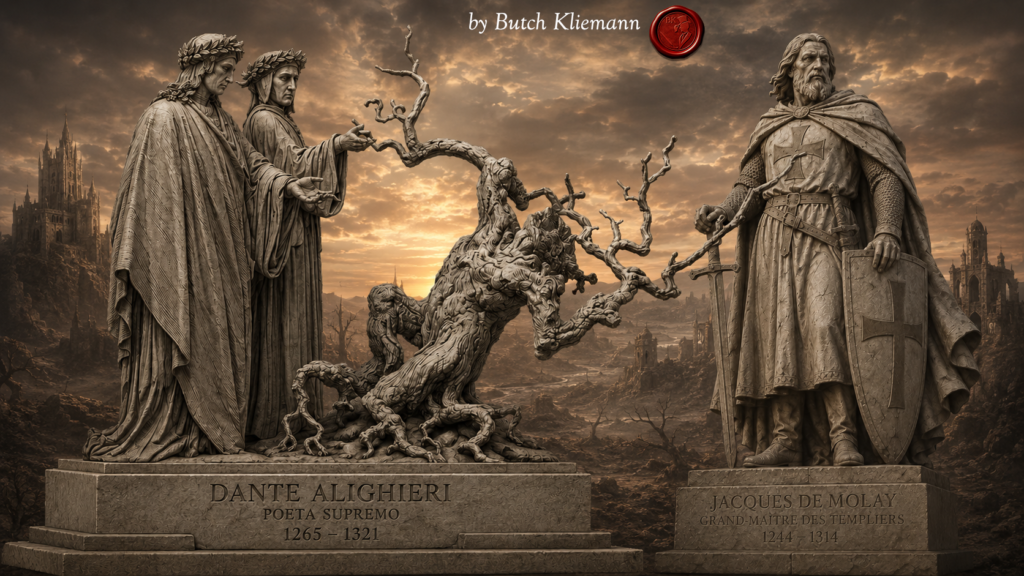
My book, Freemasons Secrets: The True Descendants of the Knights Templar, explores the conflict between the Ancients and Moderns, the mystery of 1717, and the hidden connections between Freemasonry, the Knights Templar, Dante, and the Catholic Church.

Available now in paperback and eBook.
Freemasons Secrets, Hidden History, Knights Templar

Hidden History: The Secret War Inside Freemasonry

Freemasons Secrets:
The True Descendants of the Knights Templar

Dermott and Dalcho: The Men Who Said the Story Wasn’t Finished

Most people are told that modern Freemasonry began in 1717.

That is the neat version.
That is the simple version.
And it is exactly why men like Laurence Dermott and Frederick Dalcho matter.

Because neither of them wrote like men who believed everything began cleanly, neatly, and completely in London in 1717.

They wrote like men who believed something important had been lost, altered, or withheld.

And once you start reading them that way, the official story begins to look far less secure.

Laurence Dermott and the fight over “real” Masonry

Laurence Dermott was not a minor voice on the fringes of Freemasonry. He became one of the most important defenders of the Ancients, the rival body that stood in opposition to the Moderns.

That matters.

Because the conflict between the Ancients and the Moderns was not just a petty disagreement over manners, wording, or style. It was a struggle over legitimacy. It was a struggle over who held the authentic tradition. It was a struggle over what Masonry really was.

Dermott did not write like a man who thought the Modern system had simply polished and improved an older fraternity. He wrote like a man who believed the Moderns had departed from the old path.

His famous work, Ahiman Rezon, was more than a constitution. It was a challenge.

It challenged the authority of the Moderns.
It challenged their version of the craft.
And it preserved the voice of men who believed that what had been handed down before 1717 was not being faithfully preserved afterward.

That is one of the reasons Dermott is so important to the hidden history of Freemasonry.

He stands as living proof that there was a serious internal battle over authenticity.

Frederick Dalcho and the deeper key

If Dermott gives us the voice of resistance, Frederick Dalcho gives us something else: a clue.

Dalcho is especially important because of what he said about the Royal Arch.

That one point alone should make readers stop and think.

For generations, the Master Mason degree has been treated as the symbolic center of the system most people know. But Dalcho pointed beyond that. He made it clear that the Royal Arch was not a side ornament or an optional add-on. He treated it as something essential.

That matters because it suggests that the visible structure of Freemasonry may not tell the whole story by itself.

If the heart of the system lies beyond the degree most people think is the summit, then the public narrative is incomplete from the start.

And once again, the neat story begins to crack.

Why these two men matter together

Dermott and Dalcho lived in different settings, but together they point in the same direction.

They both force us to ask uncomfortable questions:

  • If Freemasonry was fully settled in 1717, why did the Ancients fight so fiercely against the Moderns?
  • If the Modern system preserved the tradition intact, why did Dermott see such a need to challenge it?
  • If the Master Mason degree contained the full heart of the craft, why did Dalcho point readers toward the Royal Arch?
  • If the official story is complete, why do so many of the insiders sound like they are guarding fragments of a larger one?

These are not small questions.

They go to the center of the entire issue.

The hidden conflict behind the public story

The common version of Masonic history tells readers that the creation of the first Grand Lodge in London was the beginning of organized Freemasonry as we know it.

But another possibility exists.

What if 1717 was not simply a beginning?

What if it was a reorganization?
A takeover?
A narrowing?
A political and symbolic shift that left older claims standing outside the new center of power?

That is where the fight between the Moderns and the Ancients becomes much more than internal housekeeping.

It begins to look like a battle over inheritance.

Who had the right to define Masonry?
Who had the right to say what belonged in it?
Who had the right to declare certain teachings central and others secondary?

Dermott fought in that war.
Dalcho preserved clues from within its aftermath.

That is why they matter.

Why this matters beyond Masonry

For some readers, this may sound like a narrow dispute inside a private fraternity.

It is not.

Freemasonry sat at the crossroads of religion, politics, symbolism, and power. When men inside it argued over authenticity, they were not merely arguing over ceremony. They were arguing over continuity, identity, and hidden inheritance.

That is why this subject connects so naturally to the wider struggles of European history.

The same age that saw divisions over thrones, churches, legitimacy, and succession also saw divisions inside Masonry itself. That is not a coincidence. It is part of the same larger pattern.

And when you place Dermott and Dalcho back into that pattern, they stop looking like obscure names in old books.

They become witnesses.

Witnesses to a conflict the official story has never fully resolved.

The deeper question

In the end, Dermott and Dalcho matter because they point to a deeper question:

Was Freemasonry really born in 1717, or was something older being fought over, redefined, and partially concealed?

That question sits at the heart of the hidden history.

And once you begin following it, you may find that the real story of Freemasonry is not the polished one usually repeated, but the fractured one preserved by the very men who refused to let the argument die.


If you want to explore that question further, start with the larger investigation in Freemasons Secrets: The True Descendants of the Knights Templar, where the conflict between the Moderns and the Ancients is placed back into the wider struggle over power, legitimacy, and hidden inheritance.

Catholic Church, Dante Alighieri, Knights Templar

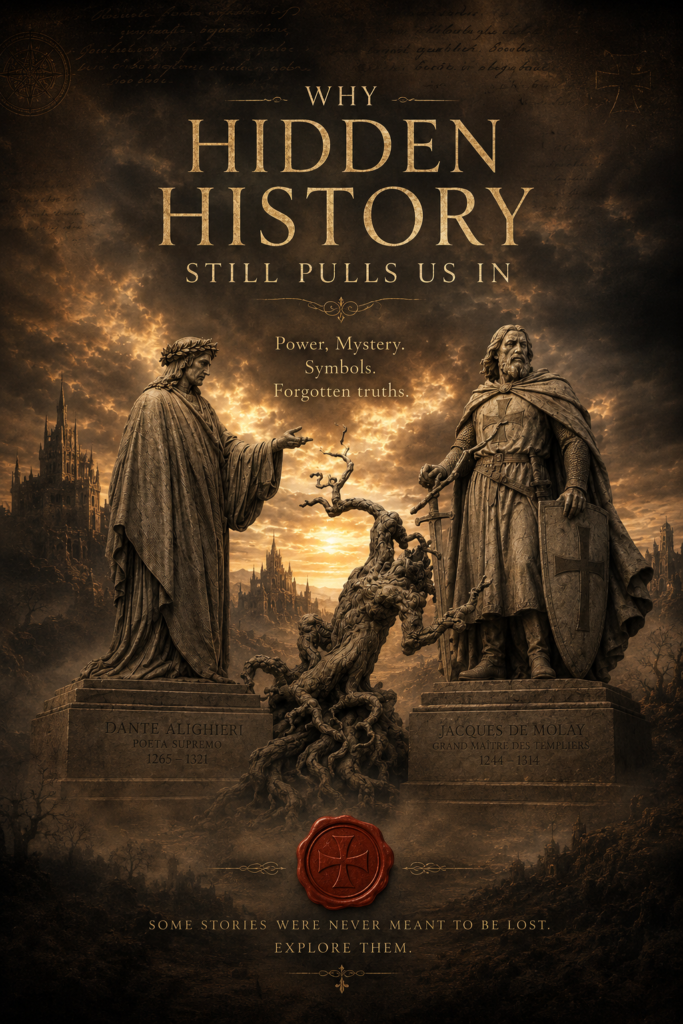
Why Hidden History Still Pulls Us In

Some stories never really go away.

They survive in symbols.
They survive in legends.
They survive in old books, forgotten conflicts, strange rituals, and questions nobody seems eager to answer.

That is why hidden history still pulls us in.

It is not just about dates, kings, popes, battles, or secret societies. Those things matter. But they are not the whole reason people keep coming back to stories about the Knights Templar, Freemasonry, Dante, the Catholic Church, lost treasure, forbidden knowledge, and symbols carved into stone.


The deeper reason is mystery.

People want to know what really happened.

They want to know why powerful institutions fought so hard to control certain stories. They want to know why some orders disappeared while their symbols survived. They want to know why certain names keep returning again and again, even centuries later.

The Knights Templar were destroyed in the early 1300s, but the mystery around them never died.

Dante Alighieri wrote one of the greatest works in Western literature, but beneath the poetry was a man watching his world fall apart. He saw conflict between popes and kings. He saw exile, corruption, ambition, and spiritual crisis. He lived in the middle of a world where power was being challenged from every direction.

Freemasonry is often explained with simple answers. But the symbols, rituals, degrees, and internal conflicts tell a much deeper story than most people realize.


That is where the trail begins.

Not with dry history.

Not with conspiracy for the sake of conspiracy.

But with the questions that refuse to disappear.

Why did the Templars have to fall?
What did Dante see in the world around him?
Why did Freemasonry need a Grand Lodge in 1717 if something older already existed?
Why do certain symbols keep surviving long after the people who used them are gone?


These are the kinds of questions that make history feel alive.

Hidden history is powerful because it sits between fact and mystery. It asks us to look closer. It asks us to question the clean version of events. It asks whether the story we inherited is complete, or whether pieces were left out along the way.

That is what this site follows.

The forgotten trail.

The symbols that survived.

The conflicts beneath the surface.

The stories that were buried, simplified, or explained away.

History is often taught as if everything is settled.

But sometimes the most important questions begin where the official story ends.

Start with the free Dante guide: What Dante Knew About the Knights Templar
Explore the full investigation: Freemasons Secrets: The True Descendants of the Knights Templar

Dante Alighieri, Freemasons Secrets, Knights Templar

Why Dante Still Matters to the Hidden History of the Knights Templar

The connection between Dante Alighieri and the Knights Templar
the link between Dante Alighieri and the Knights Templar

Most people read The Divine Comedy as poetry.

That is understandable. Dante Alighieri created one of the greatest works of literature in history. His journey through Hell, Purgatory, and Paradise has been studied for centuries.

But Dante was not only writing poetry.

He was writing from exile. He was writing during one of the most unstable periods in medieval Europe. The authority of kings and popes was being challenged. Political factions were tearing cities apart. The Knights Templar were about to be destroyed. The Church and the Crown were locked in a struggle that would reshape the Western world.

He was writing from exile. He was writing during one of the most unstable periods in medieval Europe. The authority of kings and popes was being challenged. Political factions were tearing cities apart. The Knights Templar were about to be destroyed. The Church and the Crown were locked in a struggle that would reshape the Western world.

Dante lived inside that world.

He was exiled from Florence in 1302 after the conflict between the White Guelphs and Black Guelphs exploded into political disaster. The White Guelphs, the faction Dante belonged to, resisted growing papal interference in Florence. The Black Guelphs supported the power of the pope and his allies.

This was not just local politics. It was part of a much larger conflict over who held true authority in Europe.

A few years later, the Knights Templar were arrested in France. Their leaders were imprisoned, accused, tortured, and eventually destroyed. The order that had once stood at the center of crusading power was brought down through the combined force of royal ambition and religious authority.

Dante saw the same world collapsing around him.

That is why his writing matters.

When Dante condemned corruption, false authority, betrayal, and spiritual blindness, he was not speaking in vague symbols. He was responding to real people, real events, and real conflicts. His work preserved a record of the anxieties and power struggles of his age.

The deeper question is this:

What did Dante understand about the world he was watching fall apart?

The answer reaches beyond poetry. It reaches into medieval politics, papal power, royal ambition, the fall of the Knights Templar, and the hidden meanings that later generations continued to preserve through symbols.

That is the trail this site follows.

Dante is not the whole story. But he is one of the best places to begin.

Want to go deeper?

Start with the free guide: What Dante Knew About the Knights Templar.

Then explore the full investigation in Freemasons Secrets: The True Descendants of the Knights Templar.

Freemasons Secrets, Hidden History, Knights Templar

Freemasons Secrets: What the Brotherhood Has Never Publicly Admitted

I know because I was inside it.

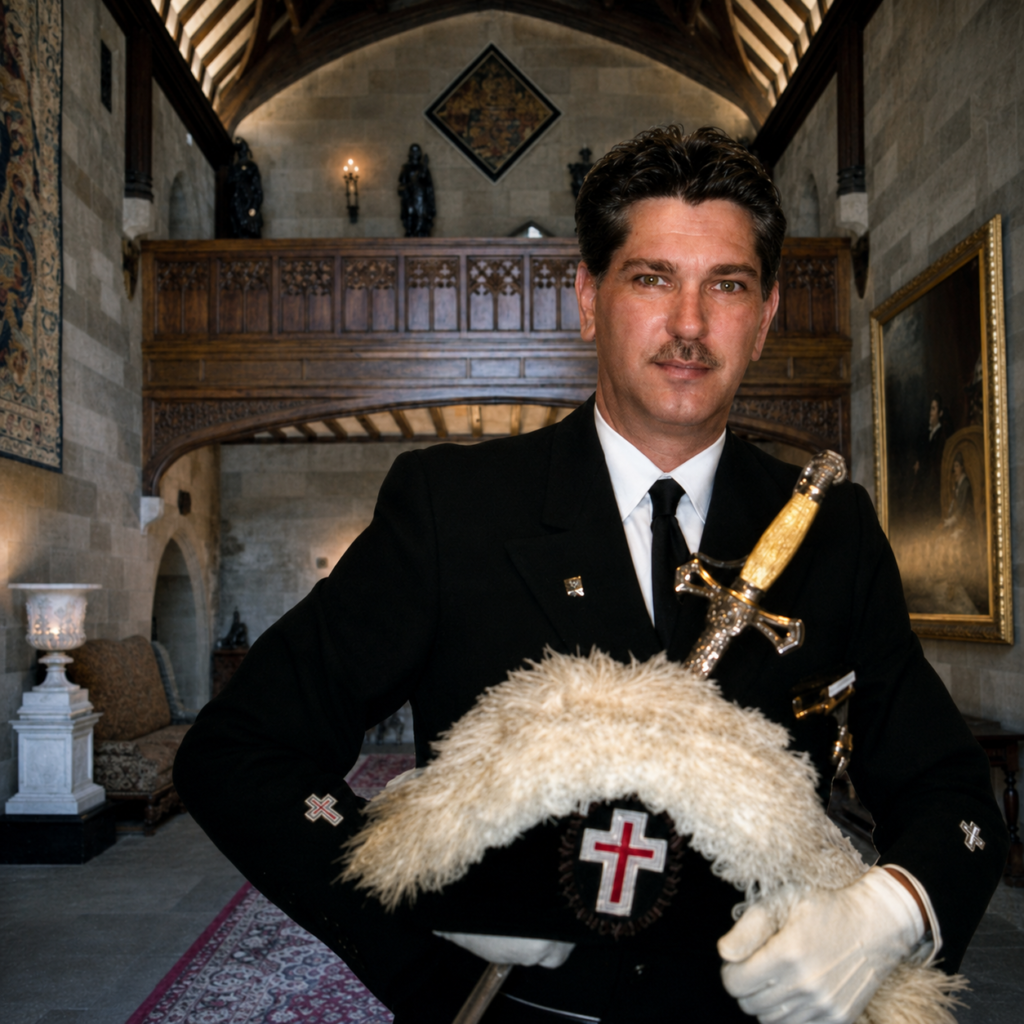
In my 30s I became a Scottish Rite Freemason and a Masonic Knights Templar. I wasn’t there to write a book or expose anyone. I went because I’d been asking questions about this organization since childhood and I wanted answers from the inside. What I found was a brotherhood layered with genuine history, encoded symbolism, and a carefully maintained silence about its own origins that most members never question.

What follows are the things Freemasonry has never publicly admitted, not because there’s a conspiracy to suppress them, but because most Masons simply don’t know them. And the ones who do rarely talk.

THE TEMPLAR CONNECTION THEY WON’T CONFIRM

Ask a Freemason whether the organization descends from the Knights Templar and most will give you a rehearsed answer. They’ll tell you the Templar connection is mythology. Romantic legend. That modern Freemasonry traces its documented origins to the stonemason guilds of medieval Europe, nothing more.

What they won’t tell you is that the symbolism doesn’t lie.

The Knights Templar were arrested on Friday, October 13th, 1307, on orders from King Philip IV of France and with the blessing of Pope Clement V. The charges were heresy, blasphemy, and secret rituals too obscene to describe in public. Most of the leadership was tortured into confession and burned. The order was officially dissolved in 1312.

But organizations with centuries of accumulated knowledge, wealth, and network don’t simply disappear because a king signs a document. The Templars had strongholds in Scotland, a country outside Philip’s reach. They had members scattered across Europe. They had secrets worth protecting.

The stonemason guild explanation for Freemasonry’s origins conveniently appears in the historical record roughly where the Templar trail goes cold. The symbolism that fills Masonic ritual, the geometry, the temple building mythology, the degrees of initiation, the sworn oaths of secrecy, maps almost perfectly onto what we know of Templar practice. That’s not coincidence. That’s continuity.

THE DEGREES AND WHAT THEY ACTUALLY MEAN

Freemasonry is structured around degrees of initiation. In the York Rite and Scottish Rite systems used in America, a Mason can advance through dozens of degrees, each one revealing more of the order’s symbolic framework. The first three degrees, Entered Apprentice, Fellow Craft, and Master Mason, are the foundation.

What most outsiders don’t realize is that the degree system isn’t just ceremony. It’s a transmission of knowledge encoded in allegory. The story of Hiram Abiff, the master builder of Solomon’s Temple who is murdered rather than reveal the secrets of his craft, sits at the heart of the third degree ritual. It is not told as history. It is performed. The initiate experiences it.

This is initiation in the oldest sense of the word. The same structure used by the mystery schools of ancient Egypt and Greece. The candidate doesn’t just learn something. He goes through something. And what he carries out of that room is different from what he brought in.

The higher degrees build on this foundation in ways most Masons in the lower degrees never fully grasp. By the time a Scottish Rite Mason reaches the 32nd degree, he has been exposed to a symbolic framework connecting Solomon’s Temple, the Crusades, the Templars, Kabbalistic tradition, and the suppressed history of the medieval Church. Most members absorb the ritual without understanding what it’s actually pointing at.

THE SILENCE ABOUT PHILIP IV AND CLEMENT V

One of the most telling freemasons secrets is what the organization chooses not to say about the destruction of the Knights Templar.

The suppression of the Templars in 1307 was not a religious purification. It was a political theft. Philip IV of France was deeply in debt to the Templar banking network, which had effectively invented the concept of international finance. He couldn’t repay what he owed. So he destroyed the creditor.

Pope Clement V, who should have protected a papal military order, was a French pope elected under Philip’s direct influence. He cooperated with the arrest, the torture, the show trials, and the dissolution. He was rewarded with continued French support for the papacy, which had by then relocated to Avignon, firmly under the French crown’s shadow.

This is the historical moment that Freemasonry’s Templar degrees are built around. The betrayal of an order by the two most powerful institutions in the medieval world. A king and a pope conspiring to destroy what they couldn’t control.

Masonic ritual preserves the memory of that betrayal in symbolic form. The murder of Hiram Abiff is not just a building metaphor. It is a coded memory of what happened to the Templars. And the obligation every Master Mason takes, to avenge that murder, carries a weight most of them never fully consider.

WHAT THE LODGE WON’T TELL YOU AT THE DOOR

None of this is hidden in the sense that it has been locked in a vault somewhere. Most of it is available to anyone willing to read seriously and connect the threads. What Freemasonry has always relied on is not secrecy exactly, but complexity. The organization is layered enough that most people, including most Masons, never get to the bottom of it.

The fraternal surface is real. The charity work is genuine. The handshakes and the aprons and the lodge dinners are exactly what they look like. But underneath that surface is a symbolic architecture that connects to some of the most consequential and suppressed history of the Western world.

That’s what I’ve spent years writing about. Not to tear the organization down, but because that history deserves to be understood. The Templars deserved better than what Philip and Clement gave them. And the people who carry their legacy forward deserve to know what they’re actually carrying.

If you want to go deeper on the real history behind Freemasonry and its Templar origins, my book covers what the degrees point to and why it matters.

Scroll to Top