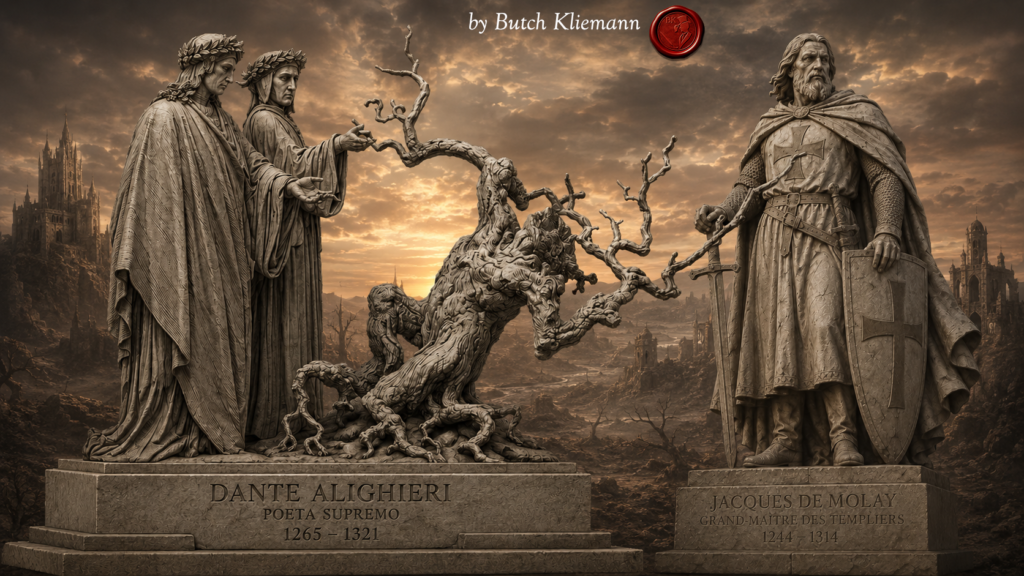
Most people read The Divine Comedy as poetry.
That is understandable. Dante Alighieri created one of the greatest works of literature in history. His journey through Hell, Purgatory, and Paradise has been studied for centuries.
But Dante was not only writing poetry.
He was writing from exile. He was writing during one of the most unstable periods in medieval Europe. The authority of kings and popes was being challenged. Political factions were tearing cities apart. The Knights Templar were about to be destroyed. The Church and the Crown were locked in a struggle that would reshape the Western world.
He was writing from exile. He was writing during one of the most unstable periods in medieval Europe. The authority of kings and popes was being challenged. Political factions were tearing cities apart. The Knights Templar were about to be destroyed. The Church and the Crown were locked in a struggle that would reshape the Western world.
Dante lived inside that world.
He was exiled from Florence in 1302 after the conflict between the White Guelphs and Black Guelphs exploded into political disaster. The White Guelphs, the faction Dante belonged to, resisted growing papal interference in Florence. The Black Guelphs supported the power of the pope and his allies.
This was not just local politics. It was part of a much larger conflict over who held true authority in Europe.
A few years later, the Knights Templar were arrested in France. Their leaders were imprisoned, accused, tortured, and eventually destroyed. The order that had once stood at the center of crusading power was brought down through the combined force of royal ambition and religious authority.
Dante saw the same world collapsing around him.
That is why his writing matters.
When Dante condemned corruption, false authority, betrayal, and spiritual blindness, he was not speaking in vague symbols. He was responding to real people, real events, and real conflicts. His work preserved a record of the anxieties and power struggles of his age.
The deeper question is this:
What did Dante understand about the world he was watching fall apart?
The answer reaches beyond poetry. It reaches into medieval politics, papal power, royal ambition, the fall of the Knights Templar, and the hidden meanings that later generations continued to preserve through symbols.
That is the trail this site follows.
Dante is not the whole story. But he is one of the best places to begin.
Want to go deeper?
Start with the free guide: What Dante Knew About the Knights Templar.
Then explore the full investigation in Freemasons Secrets: The True Descendants of the Knights Templar.